Skip to content
LLM Visibility Tracker

AI citation tracker

Every link ChatGPT, Gemini, Claude, Perplexity and Google's AI Overviews cite for your prompts, sorted by kind of site, plus the pages that keep pointing answers at your competitors.

  • Closed beta
  • $0 while in beta
  • Your own DataForSEO key
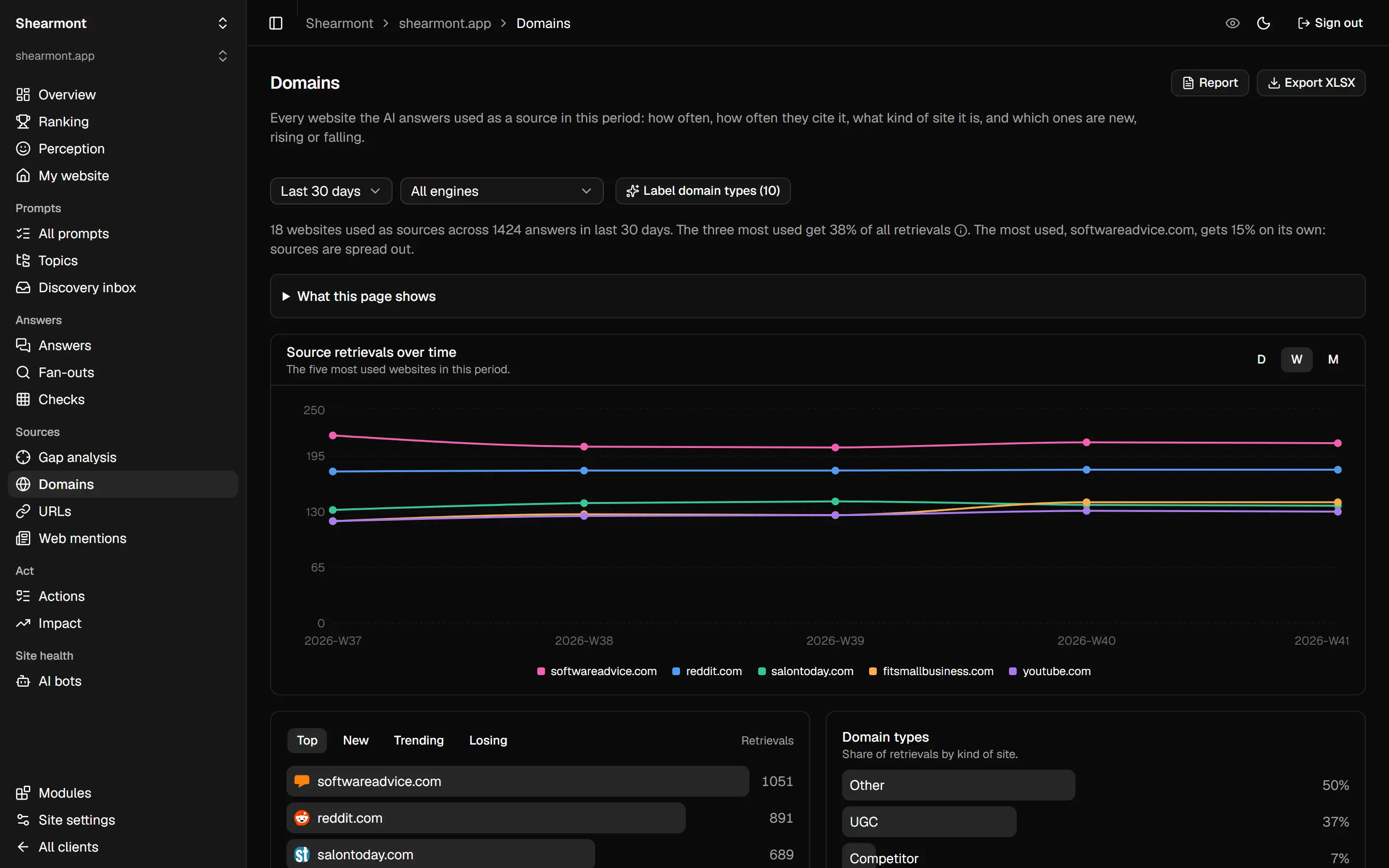
Domains: every site the AI answers used as a source, with retrievals over time, top, new, trending and losing views and domain types
Every site the answers used, by week, with its type.

What you get for every source

First, what even counts as a citation

An AI citation tracker has to settle one thing first: what counts. My rule: an answer used a page if that page shows up in its cited sources, or, on ChatGPT, in the pages it looked up while answering.

The organic results that come back alongside an AI Overview are out. That's Google ranking pages, not the AI reading them. Padding the numbers with them would be easy, and dishonest as hell.

And a page the bots can't read is a page they can't cite. The free AI crawler test shows which AI bots your robots.txt lets in.
Every source, typed

Every domain lands in a bucket. Your site and your competitors' get sorted first. Then built-in rules catch the famous sites, anything on a government or education suffix, plus docs and support hosts. Whatever's still unlabelled can go through an optional AI pass, quoted up front, and it only ever sees domain names.

Pages get typed as well, by address or title. Now you can tell whether the engines in your niche feed on forums and review sites or on editorial "best of" lists.

Domain types

  • You
  • Competitor
  • Editorial
  • UGC
  • Corporate
  • Reference
  • Institutional
  • Other

Page types

  • listicle
  • comparison
  • alternative
  • product page
  • category page
  • homepage
  • profile
  • discussion
  • how-to guide
  • article

Domains and URLs: who's up, who's new, who's sinking

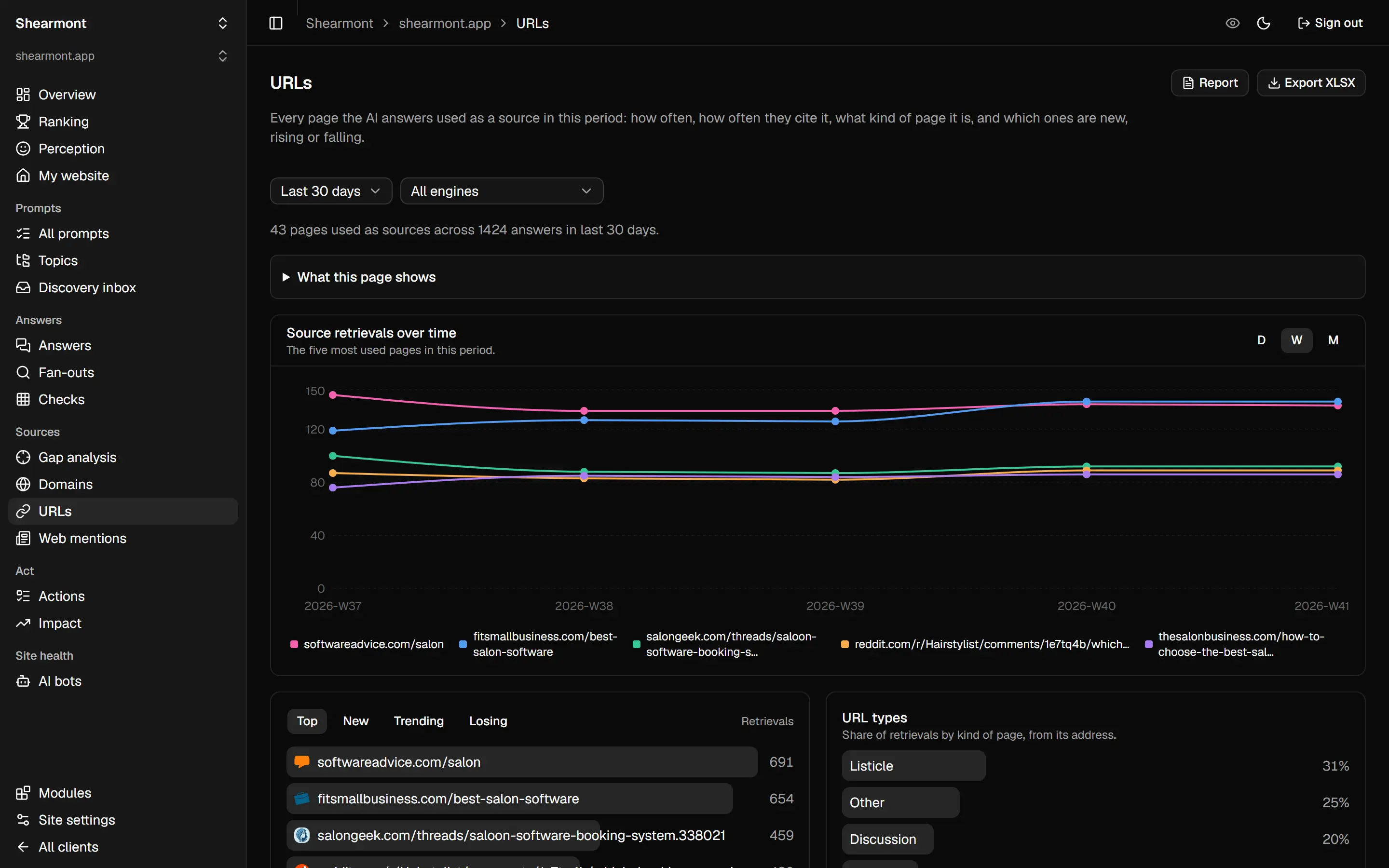
The Domains and URLs pages list every site and page the answers touched in the period, with retrievals, retrieval rate, citation rate and type. Four views: Top; New, for sources that showed up for the first time this period; Trending and Losing, each measured against the period before it of equal length.

Click any domain or URL for its own page and the answers that used it.

URLs: every page the answers used, with retrievals over time, top, new, trending and losing views and the share of each URL type
The pages the answers used, by week. In the demo, listicles and category pages lead.

Gap analysis: cited for them, not for you

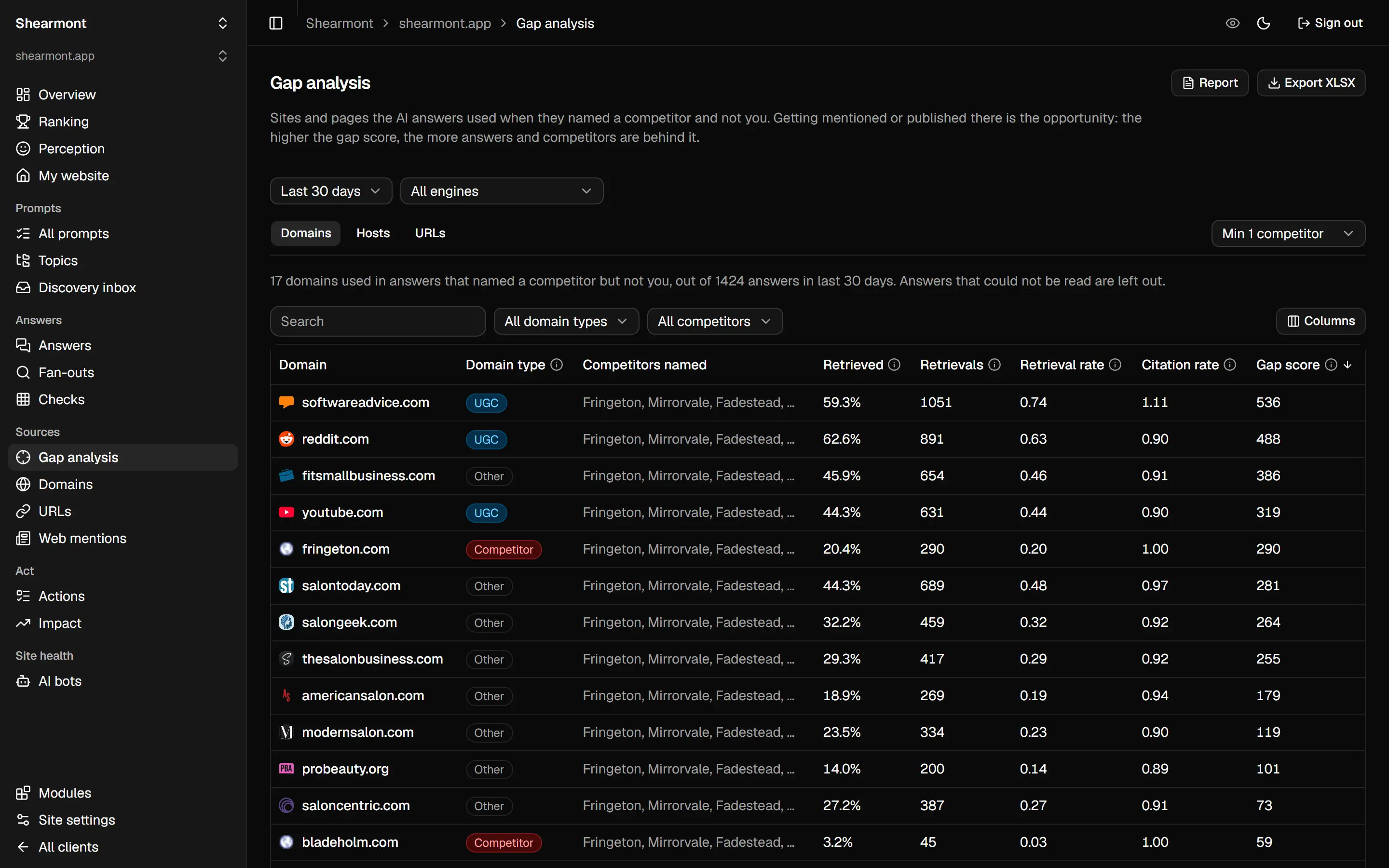
A gap answer used a source and named a tracked competitor or more, but not you. Every source gets a gap score, and more answers and more rivals behind a site push it higher. Flip between domains, hosts and URLs, filter by type or competitor, or set a floor on how many different competitors a site's gap answers have to name.

That list is your outreach plan. Actions takes the third-party sites with a gap score of 2 or more over the last 90 days and puts the top ten on your work list, each with the answers behind it.

Gap analysis table: sources behind answers where a rival got named and the demo brand didn't, showing domain type, retrievals, citation rate and gap score
The sites feeding answers that pick a rival over you, sorted by gap score.

My website: cited without being named

My website shows which of your pages the engines read, and the answers that used one of them without naming your brand. That's a strange way to lose: the engine trusts your content and still doesn't say your name. Each page like that turns into an action to make the brand clear on it.

Open the full demo scoreboard

What it costs

Zero extra. Sources arrive with every answer the AI rank tracker collects anyway, and the source pages get built from answers you already stored. So citation tracking costs exactly what the checks cost: run 100 prompts a week through Perplexity, AI Overview, Gemini and ChatGPT and DataForSEO bills about $4.77 a month. The one add-on is the optional AI pass that labels domain types, and it quotes you before it runs.

The tool is free while it's in beta. Paid plans come later and will cost under $10 a month.

See the plans
Citation tracking, on top of the checks
$0
100 prompts a week, four engines
$4.77/mo
The tool, while it's in beta
$0

Prices: DataForSEO, from the app's price catalog.

How it's measured

Each page is counted under its cleaned-up address, utm tags and #fragments stripped. Domains roll up to the registrable domain, so blog.example.com counts toward example.com; switch to hosts when you need the subdomain kept apart.

For gaps, an unknown answer can't be a gap, and your own domain is never on the list.

How a check runs

How it works
  1. Add prompts

    Take what discovery digs up, or drop in a list you already have.

  2. Get a quote

    Calls, estimate and ceiling, before a single request goes out.

  3. Read the board

    Who got named, in what order, and which sites got cited.

Questions people ask

Which engines give citations?

All five hand back the links behind their answers: ChatGPT, Gemini, Claude, Perplexity and Google's AI Overview. ChatGPT goes further and lists the pages it looked up, too. If an engine returns no citations, it sits out the Used as a source rate rather than dragging it to zero.

What's the difference between a retrieval and a citation?

A retrieval is an answer that used the page, cited or looked up. Citation rate is the page's citations divided by the answers that used it. Some engines list one page once per reference, so it can go above 1.

How is the gap score worked out?

Grab every answer that used the source and named one or more of your tracked competitors, but not you. Count the competitors in each of those answers and add them up. That sum is the gap score. The formula's printed right on the page, no secret sauce.

Can I export the citations?

Yep. In the XLSX export, citations get a sheet of their own, a row for each one, never a comma-separated pile of links in a single cell. Or print the one-page report, or send a read-only share link.

Does it show which of my own pages get cited?

Yes. My website lists the pages of yours the engines read, and the answers that used one of them without naming your brand.

Get in the beta.

No credit card. No onboarding call. Drop your email and I'll send an invite when there's room.

See pricing